What Will You Make in a Sushi Lesson in Tokyo?

Almost every sushi class in Tokyo teaches nigiri plus one roll form, but which second style, which fish, and how much of it changes a lot from studio to studio. I've sat through this circuit enough times to know that a class's menu is often the real difference-maker, not the price or the neighborhood. This guide walks through exactly what ends up on your board across the six classes I track, the fish you'll actually handle, and why a lesson inside Tsukiji's outer market feels different from one in a Shinjuku studio kitchen. By the end you'll know which class teaches the style you actually want to learn.
Quick answer
Almost every sushi class in Tokyo teaches nigiri plus one roll form, usually maki or temaki. A few classes add extras: inari pouches, tamagoyaki omelette, or a California roll, but gunkan (battleship sushi) is rarely part of a 90 to 100-minute tourist lesson even though it's a standard shop style.
Key takeaways
- Nigiri appears in every class on this site; the second style, maki, temaki or inari, is what actually differs between them
- The Shinjuku 3-hour course teaches the widest menu: nigiri, inari, hosomaki, California roll, plus tamagoyaki
- Shibuya's class is the one exception, temaki-only, hand-rolled cones rather than pressed nigiri
- Gunkan (battleship sushi) is a real shop style but you almost certainly won't shape one in a standard tourist lesson
- The Tsukiji market class pairs its four nigiri and one maki with a live fish-cutting show most studio classes don't offer
- See the table below for exactly which class teaches which style
The Menu at a Glance
The canonical rundown of sushi styles, what your hands actually do for each, and which lessons on this site teach them.
| Style | What it is | Difficulty at the board | Which Tokyo lessons teach it |
|---|---|---|---|
| Nigiri | Hand-pressed oval of rice topped with a slice of fish | Easy once demonstrated, the most forgiving shape for a first attempt | Every class on this site |
| Hosomaki / maki | Thin roll of rice and filling wrapped in nori, sliced into rounds | Moderate, rolling evenly takes a couple of tries | Asakusa, Tsukiji, Shinjuku, Ginza |
| Temaki | Hand-rolled cone of nori, rice and filling, eaten straight from the hand | Easy, no slicing required, the most beginner-forgiving roll | Shibuya (temaki-only class) |
| Gunkan | Rice base wrapped in a nori collar, topped with something loose like roe or uni | Fiddly, needs a steady nori wrap most beginners haven't practiced | Rarely taught in 90 to 100-minute formats, honesty note below |
| Inari | Sweet fried tofu pouch stuffed with seasoned rice | Easy, mostly stuffing rather than shaping | Shinjuku (3-hour course) |
| California roll | Inside-out roll with avocado, cucumber and surimi | Moderate, the inside-out technique differs from a standard maki | Shinjuku (3-hour course) |
| Tamagoyaki | Sweet rolled Japanese omelette served alongside your sushi | Easy, more cooking than shaping | Shinjuku (3-hour course, the only class that adds it) |
Gunkan deserves the honest flag it gets in that table. It's a completely standard style at any Tokyo sushi counter, but the loose, roe-topped fill needs more practice than a single tourist lesson has time for, so don't book expecting to leave with gunkan under your belt unless an operator explicitly lists it.
The Styles You'll Shape, One by One
Nigiri (握り)
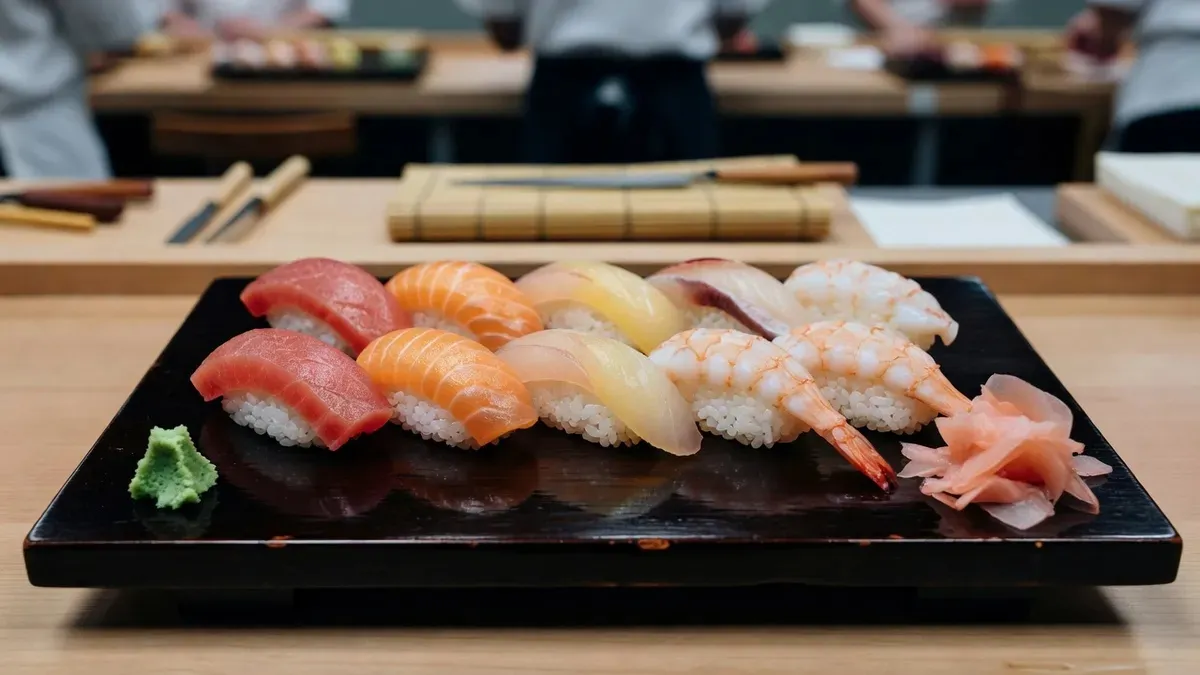
The three-finger press that shapes rice into an oval, then a slice of fish draped over the top, sometimes with a dab of wasabi tucked underneath. It's the one style every class on this site teaches, and it's also the most forgiving for a first attempt, a slightly lopsided nigiri still tastes exactly the same as a perfect one. The happi-coat session focuses almost entirely on nigiri with fresh tuna and salmon, making it the most concentrated nigiri practice of any class here.
Hosomaki / Maki (細巻き)
Rice and a single filling spread on a nori sheet, rolled tight with a bamboo mat, then sliced into rounds. The roll itself takes more coordination than nigiri, keeping even pressure so the slices come out clean rather than lopsided. The Asakusa class pairs maki with nigiri in one 100-minute session, so you leave having practiced both major styles rather than just one.
Temaki (手巻き)
A hand-rolled cone rather than a sliced roll, filled and eaten straight away with no cutting required. It's arguably the easiest style to get right on a first try, since there's no even-slicing step to fumble. Shibuya's temaki-only format builds an entire class around this one style, teaching the golden ratio of fillings, how much tuna, salmon and shrimp balances a cone without it falling apart.
Gunkan (軍艦)
A rice base wrapped in a standing collar of nori, topped with something loose that a maki roll couldn't hold, roe, uni, or a soft filling. It's a real, common shop style, but the collar wrap and loose topping need more repetition than a single 90 to 100-minute lesson allows, so it's genuinely rare to see it on a tourist class menu here even though the technique itself isn't difficult once practiced.
Inari (稲荷)
A sweet fried tofu pouch, already prepared, that you stuff with seasoned rice rather than shape by hand. It's closer to assembly than technique, which is exactly why the three-hour small-group course can fit it in alongside three other styles without the class running long.
California Roll
An inside-out roll, rice on the outside instead of nori, filled with avocado, cucumber and surimi. The technique flips the usual maki logic, which makes it a genuinely useful thing to practice if you've ever wondered how restaurant rolls look different from home attempts. Only the Shinjuku course teaches it here, alongside its wider four-style lineup.
Tamagoyaki (卵焼き)
A sweet, layered Japanese omelette cooked in a rectangular pan and sliced into pieces, served alongside your sushi rather than topping it. It's more cooking than shaping, folding thin layers of egg one at a time, and the Shinjuku 3-hour course is the only class on this site that adds it to the menu, part of what makes that format the deepest technical option here.
The Fish on Your Board
Tuna (maguro) and salmon (sake) are the two fish nearly every class puts in front of you, joined by shrimp (ebi) in the temaki-focused Shibuya class and the wider Shinjuku menu. What separates the classes more than the species list is the sourcing and grade. At the Tsukiji market class with the fish-cutting show, the pro chef grates fresh wasabi and performs shari-kiri, the rice-cutting technique that folds vinegar through warm rice, right in front of you, using ingredients bought that morning at the adjoining market.
The private Ginza lesson goes further still, Edomae-style nigiri and maki built around seasonal, premium-grade ingredients chosen for that day rather than a fixed weekly order. Studio classes in Asakusa, Shibuya, Shinjuku and the happi-coat format use solid, standard-grade fish, entirely fine for learning technique, just not the same tier as what a market class or private lesson sources. None of this is guaranteed by species alone, ask at booking if a specific grade or sourcing detail matters to you.
Market Classroom vs Studio Kitchen
The Tsukiji market class runs inside a classic Japanese-style classroom set inside the market itself, market classroom inside the outer market rather than a separate studio, which means the fish on your board was likely selling a few stalls away that same morning. Tsukiji's wholesale inner market, the huge tuna-auction operation, actually relocated to Toyosu in October 2018, but the outer market, its narrow lanes of food stalls and small classrooms including this one, stayed exactly where it was, so the market-class experience itself didn't move or change. Studio classes in Asakusa, Shibuya and Shinjuku trade that market-adjacent setting for a calmer, purpose-built kitchen, no stairs-only third-floor market building, more room to spread out at the counter, and a setting that's easier for anyone with mobility concerns.
Neither format is objectively better, the market class adds atmosphere and a live fish-cutting demonstration you won't get anywhere else on this site, while a studio class trades that for comfort and a more predictable, spacious room.
Do You Eat Everything You Make?
Yes, every class here ends with a sit-down tasting of your own work, not a rushed grab-and-go. The Shibuya class turns this into a full feast, hand rolls alongside miso soup and green tea, and most of the other formats follow the same pattern: you eat what you shaped, plus a bowl of miso soup to round it out. The Tsukiji market class adds a traditional dashi soup to the sit-down meal, sourced from the same market setting the rest of the lesson runs in.
Nobody leaves a class hungry, and the tasting is treated as part of the lesson rather than an afterthought tacked on at the end.
What Comes Home With You
Beyond the meal itself, a few classes send you home with something tangible. The Ginza lesson provides a certificate of completion and a souvenir, a nice touch for a private, higher-end booking. The Shinjuku 3-hour course sends every participant home with a recipe pack, written instructions to recreate each dish from the class in your own kitchen.
But the thing that genuinely survives the flight home from every class, whether or not a paper certificate comes with it, is the technique itself, the rice-pressing grip, the roll tension, the fish-placement habit, all of which stick with you far longer than a printed card does.
| Class | Styles you'll shape | What you take home |
|---|---|---|
| Asakusa | Maki, nigiri | The technique and the quiz you opened with |
| Tsukiji market class | Four nigiri, one maki | The technique, plus a market-sourced meal with dashi |
| Ginza private | Edomae nigiri and maki | Certificate of completion and a souvenir |
| Happi-coat | Nigiri (tuna, salmon) | The technique, and photos in the happi coat |
| Shibuya | Temaki only | The golden-ratio filling technique |
| Shinjuku (3-hour) | Nigiri, inari, hosomaki, California roll, tamagoyaki | A recipe pack to recreate every dish |
Nigiri is the one constant across every sushi class in Tokyo; everything else, maki, temaki, inari, tamagoyaki, is what actually separates one booking from another. If you're weighing whether shaping it all yourself is worth the fee compared to just eating out, is shaping it yourself worth the fee walks through that math directly. If you'd rather see the full first lesson laid out before deciding, step-by-step first lesson covers exactly what to expect from booking to the last bite.
Frequently Asked Questions
How many pieces do you actually make in a sushi class?
It varies by format. The Tsukiji market class produces exactly four nigiri and one maki roll, while the Shinjuku 3-hour course covers four separate styles plus tamagoyaki, so total piece counts run higher there.
Can you choose what goes on the menu?
Not usually, the menu is set by the class format you book, though dietary substitutions like vegan or gluten-free versions are often available with advance notice.
Is a sushi class a full meal or just a taste?
A full sit-down meal. Every class ends with you eating everything you made, and most add miso soup and green tea alongside it.
Will I learn to make gunkan (uni or roe topped sushi)?
Almost certainly not. Gunkan is a standard shop style, but its loose topping and nori-collar wrap need more practice than a 90 to 100-minute tourist lesson allows, so it rarely appears on these menus.
Do classes teach how to season the rice itself, or is it pre-made?
Most classes start with rice that's already seasoned. The Shinjuku 3-hour course is the exception, teaching how to season sushi rice from scratch as part of its longer format.
Are there vegetarian versions of these styles?
Several classes offer vegetarian, vegan or gluten-free substitutions with advance notice, though the exact swap depends on the operator, so it's worth confirming before booking rather than assuming.
What's the price range across these different menus?
Class menus run from $45 for the temaki-only format up to $119 for the private Edomae lesson (roughly ¥7,100 to ¥18,700 at ~¥157/$, August 2026), broadly tracking how many styles and how premium the ingredients are.