First Sushi Lesson in Tokyo: What to Expect, Step by Step

You don't need any kitchen experience, or even chopstick confidence, for your first sushi class in Tokyo. Instructors demonstrate every fold and press before you touch the rice, and the whole two hours moves at a pace built for total beginners rather than aspiring chefs. My own first lesson I worried about crushing the rice or holding the knife wrong; ten minutes into the demo, watching an instructor slow the same move down three times without a flicker of impatience, that worry was gone. What follows is the exact minute-by-minute walkthrough of a first lesson, the nerves that turn out to be nothing, the honest answer on raw fish and kids, and which class fits a nervous first-timer best.
Quick answer
No cooking or knife experience is needed for a first sushi class in Tokyo. Every class on this site runs in English with an instructor demonstrating each step before you try it, and lessons run from 100 minutes to 3 hours depending on the format you pick.
Key takeaways
- No prior experience is required; instructors demonstrate every technique before you attempt it yourself
- Every class runs with English-speaking instructors or interpreting guides, so language is never a barrier
- The shortest format is the 100-minute Asakusa class; the longest is the 3-hour Shinjuku course, so pick by attention span
- Children aged 4 and over join the happi-coat class as paid participants, with cooked and vegetarian alternatives available for kids wary of raw fish
- The most common first-timer worry, ruining the rice, dissolves within the first few minutes for nearly everyone
- Prices for a first lesson start at $45 (~¥7,100 at ~¥157/$, August 2026)
Zero Knife Skills Required: Who These Lessons Are Built For
Every class in Tokyo built for visitors, not aspiring chefs, assumes you're starting from nothing. The instructor demonstrates the full sequence first, rice-pressing, fish-placing, rolling, then walks the room correcting hands one at a time rather than expecting you to copy from memory. Knives barely enter the picture for a beginner: the sharpest tool most first-timers touch is a butter-knife-dull rice paddle, and any real blade work, like the fish-cutting demonstrations, is performed by the chef for you to watch, not something you're handed to try.
Fitness demands are essentially none, you're seated or standing at a counter for the whole lesson, no lifting, no standing for hours. The closest thing to a prerequisite is patience with your own first attempt looking lopsided, and every instructor on this circuit has seen far worse than whatever you'll produce. If you want the full range of hands-on sushi classes across Tokyo's sushi lesson lineup, all of them assume zero prior experience as the baseline, not the exception.
Apron On to Last Bite: A First Lesson, Minute by Minute
The chronology below is the rhythm most first-timers actually move through, from booking to the last bite.
| Stage | How long | What happens |
|---|---|---|
| Booking & the day before | - | Confirmation email arrives with the studio address; nothing to prepare beyond an empty stomach |
| Welcome & hand-washing | 5 to 10 minutes | Apron on, hands washed at a sink near the counter, seats assigned |
| Rice & shaping demo | 10 to 15 minutes | Instructor shows the full sequence once, slowly, before anyone touches rice |
| Your turn at the board | 45 to 90 minutes depending on format | Hands-on shaping and rolling with the instructor correcting as they circle the room |
| Eating what you made | 20 to 30 minutes | Sit-down tasting of everything you shaped, often with miso soup and green tea |
Booking & finding the studio
A confirmation arrives by email with the studio address and a map link; the beginner-friendly Asakusa class sits three minutes from Asakusa Station, while the Shinjuku course is tucked on the second floor of a residential building the confirmation flags by name so you don't wander past it. Nothing needs preparing the night before beyond showing up hungry, since you'll be eating everything you make.
Welcome and hand-washing
Every class opens the same way: aprons handed out, hands washed at a sink near the counter, and seats assigned so an instructor can see every pair of hands at once. The Asakusa class adds a short, genuinely fun sushi history quiz here before anyone touches rice, a warm-up that also breaks the ice in a room full of strangers.
Rice and shaping demo
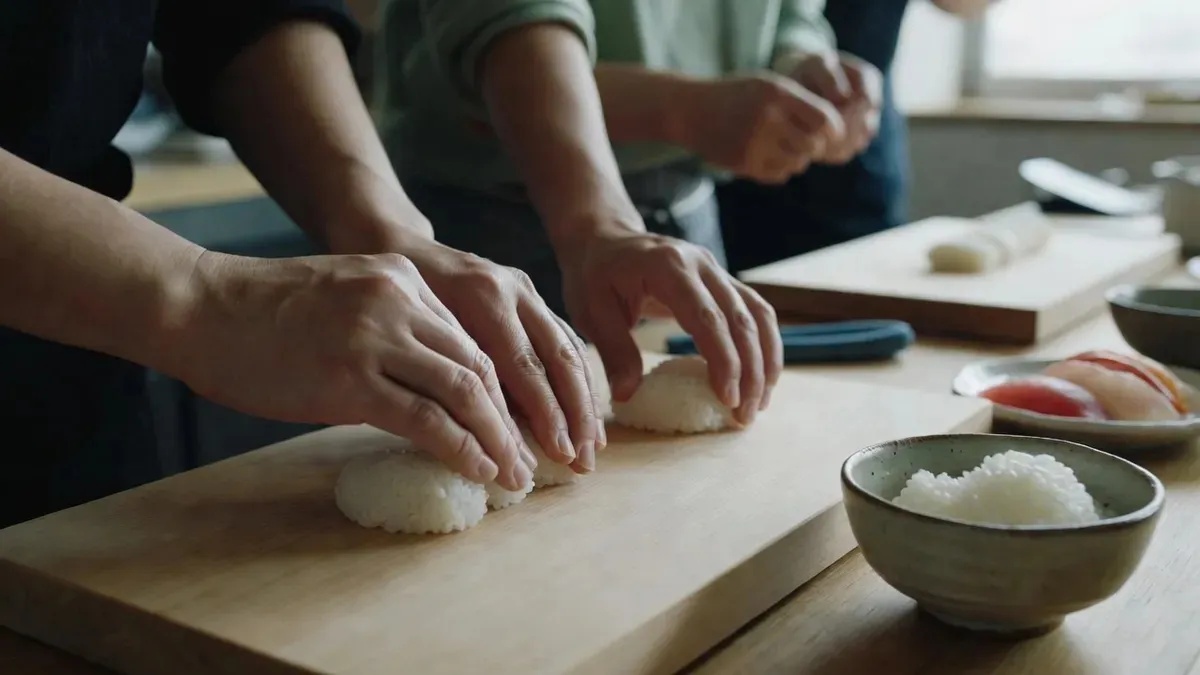
The instructor demonstrates the complete sequence once, slowly, often narrating each move a second time on request: how much rice to scoop, the three-finger press that shapes it, how a slice of fish drapes over the top without tearing. Nobody touches rice during this stage, it's purely watch-and-absorb, which is exactly why the hands-on stage that follows feels less intimidating than it sounds.
Your turn at the board
This is where the real time goes, 45 minutes in the 100-minute Asakusa format, closer to 90 minutes across the 3-hour Shinjuku course. An instructor circles the room correcting grip and pressure hands-on rather than lecturing from the front, and a lopsided first piece is treated as completely normal rather than something to redo under pressure. At the Tsukiji class, you don't fillet anything yourself, the pro chef performs the fish-cutting show while you focus entirely on shaping and rolling what's already prepared for you.
It all happens in English
Every class this site lists runs with English-speaking instructors or interpreting guides throughout, not just for a scripted welcome line. Questions get answered in the moment, mid-demo, and instructions are repeated as many times as a table needs without anyone rushing you along. Etiquette gets taught alongside technique too, the Shibuya lesson covers why you dip the fish side, not the rice, into soy sauce, a detail most first-timers never knew they were doing backward.
Eating what you made
Every class ends the same way: you sit down and eat everything on your board. Most formats close with a full meal alongside your handmade sushi, miso soup and green tea included, and the Shinjuku course sends you home afterward with a recipe pack so the technique doesn't stay behind in Tokyo.
The Jitters List: What First-Timers Worry About vs What Happens
Worth naming directly rather than glossing over, since every one of these turns out smaller than it feels beforehand.
| Worry | The reality | What helps |
|---|---|---|
| I'll ruin the rice | Rice-shaping is taught with a slow demo first, and instructors expect a lopsided first attempt | Watch the demo twice if needed and copy the exact hand position, not the speed |
| I'm squeamish about raw fish | Instructors handle all the raw-fish prep; you're placing pre-cut slices, not touching whole fish | Ask about the cooked or vegetarian menu options if raw fish genuinely puts you off |
| I don't speak Japanese | Every class runs in English with instructors who repeat steps as needed | Ask questions mid-demo; nobody minds slowing down for a total beginner |
| My chopstick skills are bad | Chopsticks are for eating at the end, not for the shaping itself, which is done entirely by hand | Use whatever grip is comfortable; it's not part of what's being taught |
| I'll be the only beginner in the room | Most classes draw a mixed room of total first-timers, since that's who books a beginner-oriented lesson | Nobody is expected to already know anything walking in |
Bringing the Family: Ages, Raw Fish and Picky Eaters
I don't have kids of my own, but I've sat in on enough family bookings to know what actually happens rather than what a listing implies. Children aged 4 and over join the happi-coat class as paid participants, dressed in a bright traditional coat that makes the whole thing feel more like a costume party than a cooking lesson, which helps with younger nerves more than any pep talk would. Kids 3 and under can share an adult's plate for free rather than booking their own seat.
On the raw-fish question, the honest answer: most formats do put real raw tuna and salmon in front of a child, and if that's a hard no for your family, ask the operator in advance about cooked or vegetable-only substitutions, since not every class can accommodate a fully cooked plate on short notice. Attention span matters more than skill here, the 90 to 100-minute formats, like the happi-coat class, suit a young child far better than the 3-hour Shinjuku course, where the pace and depth are built for adults who want the full technique rather than a quick, photogenic activity. If you're weighing which format actually fits your family, the happi-coat session that takes kids from age four is the one built with that age group in mind from the start.
Vegetarian, Vegan, Gluten-Free and Halal: How Classes Handle It
The Asakusa class offers vegan, gluten-free and halal menus on request, built as real substitution menus rather than a plate with the fish quietly removed. The happi-coat and Shinjuku classes take vegetarian, vegan, gluten-free and allergy requests too, but both require advance notice, not a same-day mention when you sit down. That advance-notice rule is the one detail worth taking seriously: several operators explicitly do not accommodate dietary changes requested on the day, so a booking confirmation email is the right place to flag anything before you arrive, not the studio counter.
If your group has a genuinely mixed set of needs, kosher included, ask directly before booking, since not every studio can stretch to every restriction, and getting a clear yes in writing beats finding out at the sink where the aprons are handed out.
Rookie Missteps That Cost You the Fun
Small mistakes that make a first lesson harder than it needs to be, all avoidable with a few minutes of planning.
- Booking the 3-hour Shinjuku course for a restless toddler instead of a 90-minute format built for shorter attention spans
- Arriving already full, since every class ends with a real sit-down meal and skipping breakfast beforehand pays off
- Skipping the advance dietary notice and assuming a same-day mention will be enough, several operators explicitly won't accommodate it
- Booking a slot the evening before during high season and finding the popular times already gone
- Filming the demo on a phone instead of watching the instructor's hands directly, then fumbling the technique when it's your turn
- Wearing anything you'd mind getting a little rice or fish oil on, aprons cover the front but not sleeves pushed up
The Lessons I'd Point a First-Timer To
Out of everything on this site, three formats genuinely suit someone walking in with zero experience.
- The beginner-friendly Asakusa class, $57, 100 minutes: the shortest format, the sushi history quiz eases nerves before anyone touches rice, and it teaches both maki and nigiri without overloading a first-timer with technique.
- The happi-coat session that takes kids from age four, $58, 1.5 hours: the natural pick for families, the costume element genuinely helps young nerves, and it stays focused on nigiri rather than juggling multiple styles.
- The three-hour small-group course, $65: the deepest option for a first-timer who wants real technique rather than a quick activity, capped at nine people, with a recipe pack to keep practicing once you're home.
What to Wear and Bring (the Short Version)
Keep it simple: closed-toe shoes if the Tsukiji venue's stairs are part of your class, sleeves you don't mind pushing up, and an appetite since every class ends with a full meal. Bring a note of any dietary restriction to hand the instructor at check-in even if you already emailed it, studios appreciate the reminder. Skip anything you'd hate to get a stray grain of rice or a drop of soy sauce on.
For a fuller sense of exactly what you'll be shaping and eating once you're at the counter, see the exact pieces you'll shape in each class.
Nothing about a first sushi lesson in Tokyo requires prior skill, fluent Japanese, or a steady knife hand. The nerves that show up beforehand, ruining the rice, feeling squeamish, worrying about language, tend to fade within the first few minutes of watching an instructor's demo. Start with the beginner-friendly Asakusa class if you want the shortest, easiest first booking, or see what each format charges if price is the deciding factor for your group.
Frequently Asked Questions
Do I need any cooking experience for my first sushi class in Tokyo?
No. Every technique is demonstrated by the instructor before you attempt it yourself, and classes are built for total beginners as the default, not the exception.
Will the class actually be taught in English?
Yes. Every class this site lists runs with English-speaking instructors or interpreting guides throughout, not only for a scripted welcome.
Is there a minimum age for kids joining a sushi class?
Children aged 4 and over join the happi-coat class as paid participants; those 3 and under can share an adult's plate for free rather than booking a separate seat.
Will my child be served raw fish?
Most formats do include real raw tuna and salmon on the board. If that's not right for your child, ask the operator in advance about cooked or vegetarian substitutions, since same-day changes usually aren't possible.
How long does a first sushi lesson actually take?
The shortest format is the 100-minute Asakusa class; the longest is the 3-hour Shinjuku course. Pick by attention span, especially for kids.
How far ahead should I book?
Popular slots sell out, so booking about three weeks ahead is the safe window in high season rather than trying the evening before.
Can classes handle vegan, gluten-free or halal diets?
The Asakusa class offers vegan, gluten-free and halal menus on request. The happi-coat and Shinjuku classes take vegetarian, vegan, gluten-free and allergy requests too, but all of them need advance notice, not a same-day mention.